Some cool things about lifting weights
My observations on lifting heavy rocks after a few years
I've been lifting weights regularly for a few short years now. It rules.
The iron never lies
Henry Rollins penned an essay many years ago where he describes how meaningful lifting weights was for a life with social and mental health challenges.
Firstly, I'm lucky to not have poor mental health, nor did I grow up with horribly bullying. But the idea that lifting weights grounds you in ways that the people and systems around you do not resonates with me:
It took me years to fully appreciate the value of the lessons I have learned from the Iron. I used to think that it was my adversary, that I was trying to lift that which does not want to be lifted. I was wrong. When the Iron doesn’t want to come off the mat, it’s the kindest thing it can do for you. If it flew up and went through the ceiling, it wouldn’t teach you anything. That’s the way the Iron talks to you. It tells you that the material you work with is that which you will come to resemble.
There's also a positive feedback cycle here:
- Lifting heavier weights is a skill that requires development
- Developing a skill makes me feel good because I know I'm getting better at things
- As my skill increases, I can lift heavier weights
- To make my heavier lifting permanent, I need to hone the skill required for that weight
And the end result is that I simply feel better about myself, body and mind, by living in this feedback loop.
It's hard and has an infinite progression curve
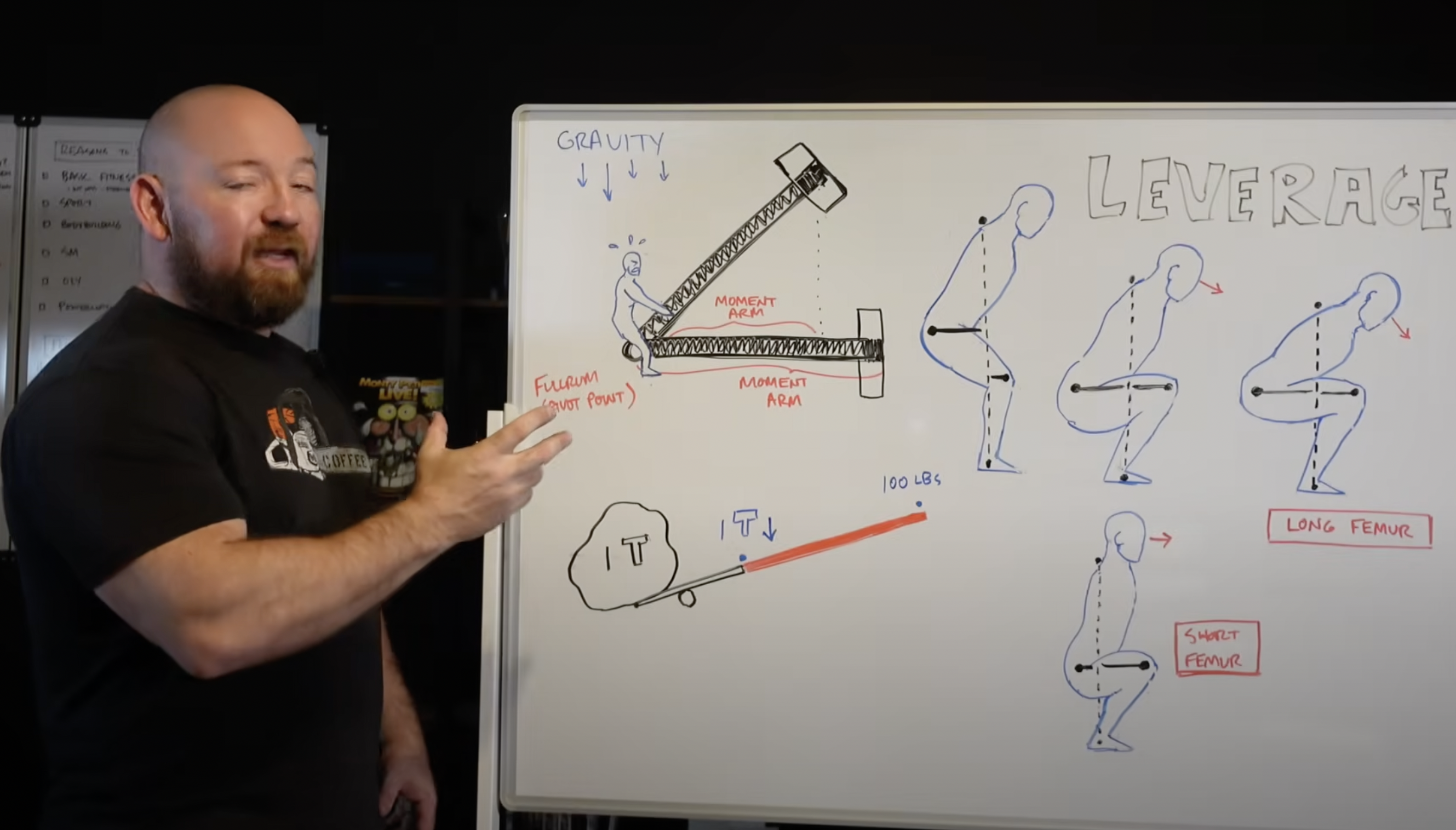
Lifting is highly complex when you break it down. Consider a classic lift like the Conventional Deadlift. Among other things, you need to:
- Position your feet and angle your toes at the right way for your body shape, which will differ based on arm length, ratio of femur to tibia length, and hip mobility
- Properly brace your core evenly across your front and sides (here's 50 pages explaining the concept)
- Execute a proper Hip Hinge to "load" your hips, glutes, and hamstrings without rocking your weight back onto your heels, leaning too far forward, or "de-loading" into your lower back
- Find the right grip width for your body proportions
- Learn the right grip for your hands (mixed grip, hook grip, purely overhand) or how to use different kinds of straps
- Once gripping the bar, engage your lats to take the slack out of the bar and start transferring tension into your hips, glutes, hamstrings, and quads
- Ensure that with your core braced, your spine is in a neutral position, not rounded, and not hyper-extended
- Pull the bar off the ground using your quads, hamstrings, and glutes in unison
- Invert your hip hinge explosively as you transfer more load and power into your hamstrings and glutes
- Keep your gaze proportional to your body and don't look up too high, which might stress your back
- Lock out the lift with your entire body stable and rigid, with nearly every muscle on the back of your body flexed strongly
- Breathe at the top, locked out, before bracing again, re-applying tension across your lats, glutes, and hamstrings, and hip hinge the weight down (as fast or slow as you can under control), and bring the bar back down to the ground
As you go through reps and sets, or do something later in the workout, each of the above steps can potentially break down, leading to a higher risk of injury and much less ability to pull the same weight.
It's difficult to pull off this symphony of mind-body connection as the weight gets heavier and the rep counts get higher. You need to focus on each movement pattern, but also know how to adjust things based on how they feel as you do them. You need to re-adjust again for various step changes in weight and reps as well: the technique you need to lift 135 pounds for 20 reps is not the same as 335 points for 3 reps.
All of this takes time and requires dedication to a progression plan. You may find that you get stuck at a particular weight and rep range, and so you need to change to lighter weight with more reps, or heavier weight with less reps to actually progress. The human body adapts in weird ways to things and no single routine will guarantee progress. Different lifts also feed into one another: improving ones's squat improves their deadlift, stronger deadlifts can improve your pullup strength (yes!), and so on.
It's an endless set of goal-setting and improvement that you can measure and feel proud of.
Bro Science is legit tribal knowledge
There's an incredible amount of science behind lifting weights, and now a new kind of lifting culture called science-based lifting. It's kinda neat! There's a lot of people out there, including those with huge followings, who review literature and try to dissect every aspect of why people go to the gym and "science" into a more optimal way to do it.
But what I find really cool about this is that for all of the near-endless studies done at universities on college-age men and women, a lot of the so-called "bro culture" or tribal knowledge by older bodybuilders from the 80s, 90s, and 2000s is generally the right stuff to follow:
- Prefer compound movements with barbells or dumbbells for the bulk of an exercise
- Fancy machines and "smaller" movements should be at the tail end of a workout
- Elevating your heart rate with some light cardio and dynamic movements significantly reduces injury
- Full range of motion beats high contraction
- Emphasizing the stretched position of a muscle gives you more muscle size and definition
- Lower rep ranges at higher weights increases your strength
- Cardio isn't bad, just do it at the end
Unscientifically, the above points have been tribal gym knowledge for decades, and we've seen it all bear out to be true in the lab environments and long-term studies too. Even though peoples' bodies vary wildly, these are generally true for everyone. It's a really cool sociological thing!
Exercise leans left wing
If the US Presidential election were held only by people who regularly exercise:
- Running
- Group classes
- Lifting weights
- etc.
The US would probably have universal health care. This is probably more influenced by age than anything else, but offhand I've noticed that most people who lift weights seriously lean more left than not. Perhaps that hopeful bias on my part.